Tag:developer tools

What Hardware should You Upgrade to Ensure Software Compatibility?

Upgrading a computer is one of the most effective ways to improve performance, extend its lifespan, and support newer applications. However, many users make purchasing decisions based solely on benchmark scores or the latest hardware releases. This is practically where they make basis on their decision when asked “what hardware should I upgrade?”. In reality, installing the fastest component available does not guarantee better performance if it is incompatible with the rest of the system.

Compatibility between hardware and software determines whether an upgrade delivers the expected improvements or creates new problems. Before replacing a CPU, adding memory, installing a solid-state drive (SSD), or upgrading a graphics card, it is essential to understand how each component interacts with the motherboard, operating system, firmware, drivers, and applications.

Start by Identifying the System Bottleneck

The first step in planning an upgrade is determining what limits your computer’s performance. Replacing hardware without identifying the bottleneck can lead to unnecessary spending and minimal improvement. Common performance issues often point to specific components:

  • Slow startup and long application load times often indicate an aging hard drive.
  • Frequent slowdowns while multitasking may suggest insufficient RAM.
  • Low frame rates during gaming usually point to the graphics card.
  • High CPU utilization during productivity tasks may indicate the processor is limiting performance.

Performance monitoring tools can help determine whether your CPU, GPU, memory, or storage consistently operates near maximum capacity. This information provides a much stronger basis for upgrade decisions than relying on specifications alone.

Once the bottleneck has been identified, compatibility becomes the next priority.

Hardware Compatibility Begins With the Motherboard
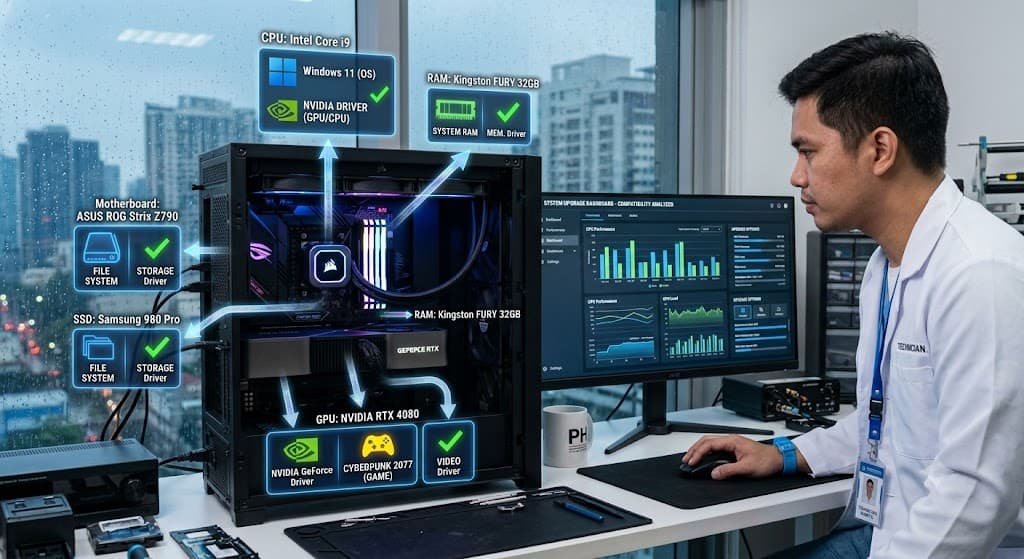
The motherboard serves as the foundation of every computer. Nearly every hardware upgrade depends on what the motherboard supports. Having said that, whenever you are thinking of doing an upgrade, first verify the following:

  • Processor socket compatibility
  • Supported chipset
  • BIOS version requirements
  • Power delivery capabilities

For RAM upgrades, confirm:

  • Memory generation (DDR4, DDR5, etc.)
  • Maximum supported capacity
  • Maximum supported speed
  • Number of available memory slots

Storage upgrades also require compatibility checks. While most modern motherboards support SATA SSDs, newer NVMe SSDs require compatible M.2 slots and PCIe support. Graphics cards introduce additional considerations, including:

  • PCIe slot compatibility
  • Physical clearance inside the computer case
  • Available power connectors
  • Adequate power supply wattage

Ignoring these requirements can prevent new hardware from functioning properly or limit its performance.

Software Compatibility is just as Important

Hardware compatibility is only part of the equation. Every component also depends on software support to function correctly.

Operating systems require appropriate drivers that allow hardware to communicate effectively with the rest of the computer. Without updated drivers, even high-performance components may experience reduced functionality or stability issues.

Some professional software also benefits from hardware certified by the software developer. Applications used for engineering, architecture, video editing, scientific computing, and 3D rendering may provide optimized performance only on supported hardware configurations.

Gamers should also consider software compatibility. New graphics cards frequently receive driver updates that improve game performance and fix compatibility issues with newly released titles. Maintaining current drivers and firmware helps ensure both performance and system stability after hardware upgrades.

Think about the Entire System instead of Individual Components

A computer functions as an integrated system. Upgrading one component without considering the others can create performance bottlenecks, like for example:

  1. Installing a high-end graphics card into an older computer with a slow processor may result in the CPU limiting gaming performance.
  2. Adding large amounts of RAM provides limited benefit if the storage device remains a slow mechanical hard drive.
  3. Purchasing the latest NVMe SSD may not achieve its advertised speeds if the motherboard supports only older PCIe standards.

Power and cooling should also be evaluated before major upgrades with some of the important considerations include:

  • Power supply capacity
  • Cooling performance
  • Airflow inside the case
  • Physical space for larger components

Balanced systems generally provide better real-world performance than computers with one exceptionally powerful component surrounded by outdated hardware.

Planning upgrades as part of an overall system strategy produces better long-term results.

Plan for Future Compatibility and Expandability

An upgrade should improve not only current performance but also prepare the system for future software and hardware demands. When selecting new components, consider:

  • Future operating system support
  • Upcoming software requirements
  • Additional upgrade paths
  • Expansion slot availability
  • Memory capacity limits
  • Power supply headroom

Similarly, choosing a slightly larger power supply today may eliminate the need for replacement when installing a more powerful graphics card later. Long-term planning helps maximize the value of every upgrade while reducing future costs.

Compatibility is the Foundation of every Successful Upgrade

The question of what hardware to upgrade cannot be answered by looking at performance specifications alone. Every successful upgrade begins with ensuring that new components work seamlessly with the motherboard, operating system, firmware, drivers, and existing hardware.

Whether replacing a processor, expanding memory, upgrading storage, or installing a new graphics card, compatibility determines whether an investment delivers its full potential. A balanced system with properly matched components will almost always outperform one built around a single high-end upgrade that creates new bottlenecks or stability issues.

By identifying performance limitations first and evaluating both hardware and software compatibility before making a purchase, users can build systems that are reliable, efficient, and ready to support future workloads. Careful planning not only improves current performance but also extends the useful life of the entire computer, making every upgrade a smarter long-term investment.

Curated Link Hubs: A Developer’s Shortcut to Smarter Coding

programmer working with curated link hub website

Software development moves at a relentless pace. Developers face tight deadlines, complex projects, and the constant need to stay updated with the latest tools and frameworks. Finding reliable resources quickly can make or break a project. Curated link hubs have emerged as a lifeline for programmers, offering a streamlined way to access frameworks, tutorials, and secure downloads without the endless search across scattered websites. These platforms save time, reduce frustration, and empower developers to focus on what they do best: coding.

Curated link hubs are a developer’s shortcut to efficiency. Instead of sifting through search engine results or outdated forums, programmers can turn to trusted directories like Address Jura (링크모음사이트) to find vetted resources. These hubs aggregate links to the latest frameworks, such as React or Django, alongside tutorials tailored to different skill levels. By centralizing high-quality content, they eliminate the need to navigate unreliable or broken links, ensuring developers get what they need with a single click.

The Power of Centralized Resources

Time is a programmer’s most precious asset. Every minute spent searching for a specific library or debugging a faulty download is a minute not spent building. Curated link hubs solve this by offering a one-stop shop for coding resources. From open-source libraries to API documentation, these platforms organize content logically. Developers can quickly find tools like Node.js updates or Python packages without wading through irrelevant results. This efficiency translates to faster project delivery and less stress.

Quality matters as much as speed. Not all online resources are trustworthy. Broken links, outdated tutorials, or insecure downloads can derail progress. Curated hubs prioritize quality by vetting their links. For example, a developer seeking a secure download for a JavaScript framework can trust a curated site to provide malware-free, up-to-date files. This reliability builds confidence, especially for junior developers who may not yet know how to spot risky sources.

Learning and Growing with Tutorials

Coding is a journey of constant learning. Whether you’re a beginner mastering Python or a seasoned developer diving into machine learning, tutorials are essential. Curated link hubs offer access to a range of tutorials, from step-by-step guides to advanced video series. These resources cater to different learning styles, ensuring every developer finds something that clicks. Why spend hours searching when a single platform can point you to the best content?

“The right tutorial can unlock hours of productivity,” says Sarah, a full-stack developer with five years of experience. She credits curated directories for helping her master new frameworks like Vue.js without the usual learning curve. By providing links to trusted tutorials, these hubs ensure developers can upskill quickly. They also highlight resources for niche topics, like cybersecurity or cloud computing, making it easier to stay competitive in a fast-evolving field.

Staying Ahead of the Curve

The tech world never stands still. New frameworks, libraries, and tools emerge constantly, and keeping up can feel overwhelming. Curated link hubs stay on top of these changes, offering developers the latest resources without the hassle of tracking them down. Whether it’s a new version of Angular or a trending DevOps tool, these platforms ensure programmers have access to cutting-edge materials. This keeps projects modern and relevant.

Collaboration thrives with shared resources. Many curated hubs allow developers to contribute links or suggest updates, creating a community-driven ecosystem. This collaborative approach ensures the content stays fresh and relevant. For instance, a developer might share a link to a new debugging tool, benefiting the entire community. Such platforms foster a sense of connection, reminding programmers they’re not coding in isolation.

Why Curated Hubs Are Here to Stay

Curated link hubs are more than a convenience. They represent a shift toward smarter, more efficient development practices. By offering secure, organized, and up-to-date resources, these platforms empower developers to work faster and better. They reduce the chaos of information overload, letting programmers focus on creating innovative solutions. As one developer put it, “Why reinvent the wheel when a curated hub already has the tools I need?”

The future of coding is streamlined. As projects grow more complex and deadlines tighten, developers will continue to rely on curated directories to stay productive. These hubs are not just about saving time; they’re about enabling creativity and precision in a demanding field. For any programmer looking to code smarter, not harder, platforms like these are an indispensable ally.

Game Development Software and Tools

Game development software is software that is used by game developers to create games. It can be used for many purposes such as creating content, prototyping, testing, and even managing the game.

While there are many different types of game development software, most of them are made specifically for 3D games. However, some tools can be used for 2D games as well. Some examples of these tools are Unity and Unreal Engine.

Read also: Be Your Own Game Developer With Google’s Game Builder

Game Development Software Tools that are actually Great for Marketing

Marketing software is a very broad topic and there are many different tools that can be used for marketing. Some of these tools are not designed specifically for marketing, but they have been adopted by marketers to make them more effective.

The best marketing software tools for marketers are those that provide the most value in their use cases and offer the most flexibility. Marketing software should not only help you with your marketing campaigns but also offer insights into your business’s data.

There are many different types of marketing software available on the market today, but some of them stand out from the rest because they provide more value than others in their use cases. These include campaign management software, website analytics software, content management system (CMS), and a social media management toolkit.

What is the Best Video Game Development Software?

Video game development software is an essential tool for video game developers. These tools help them to create and test their games. They can also use these tools to build prototypes and experiment with different ideas.

The best video game development software is the one that has a wide range of features and capabilities, has a low learning curve, and most importantly, is easy to use.

Video game development software is also, in most cases, the same software used to create “cheats” like scripting.

What is Scripting in Video Games?

Scripting is an essential part of video games, and it has been a part of the gaming industry for years. An example of scripting is LoL Scripts specifically programmed for League of Legends. Scripting refers to the process of writing a series of instructions that are then carried out by computer software or by other game systems in order to control the action in a game.

Scripts are usually created by programmers or designers who need to make sure that every step in the game is programmed correctly and can be followed as intended. This allows for more complex games with more nuanced gameplay. Scripting also allows for players to have more freedom within their own playthroughs, as they can choose how they want to proceed through a given level or what side missions they want to complete first.

What are the Most Popular Game Development Platforms on Market Today?

PC gaming has been a popular industry for many years. With the growing prevalence of digital games, the PC game market is expanding as well. The most popular gaming platforms in the market today are Unity, Unreal Engine, and CryEngine.

PC gaming software platforms:

  • Unity
  • Unreal Engine
  • CryEngine

Best Free Video Game Design Software Available in the Market Today

Video game design is a difficult task and requires a lot of time, effort, and creativity. However, there are a few tools that can make the process easier. Here are the top 3 free video game design software available in the market today.

1) Game Maker Studio

2) Unity

3) Unreal Engine

Conclusion: Game Development Software and Tools

In the past, game developers used to create games using a combination of their skills and experience. But now, with the help of game development software tools and tools, they can now focus on what they are best at – creativity and emotions.

As technology advances, game developers are able to create new games faster than ever before. They can also make sure that the games they produce are fun and engaging for their players.


𐌢